Standards integration landscape
Agent Manifest is an integration point, not a replacement for an Agent Card, credential, registration record, bill of materials, provenance statement, attestation format, or runtime evidence. Each record keeps its existing owner and lifecycle. Small, signed references connect them.
This page is informative. It describes the intended integration boundary and does not add fields or conformance requirements to the Agent Manifest specification.
How the records relate
In simple terms:
- Discovery records say what the agent claims to be. The registration record and Agent Card identify the owner, endpoint, skills, and protocols.
- Build records say what was approved. The BOM, build provenance, and platform evidence are linked by exact digest from the Agent Manifest.
- A relying party makes the decision. It checks the credential and the exact manifest, then admits, restricts, or blocks the agent.
- Runtime records say what happened next. TRACE or OCSF evidence links each action back to the exact manifest and agent instance that was admitted.
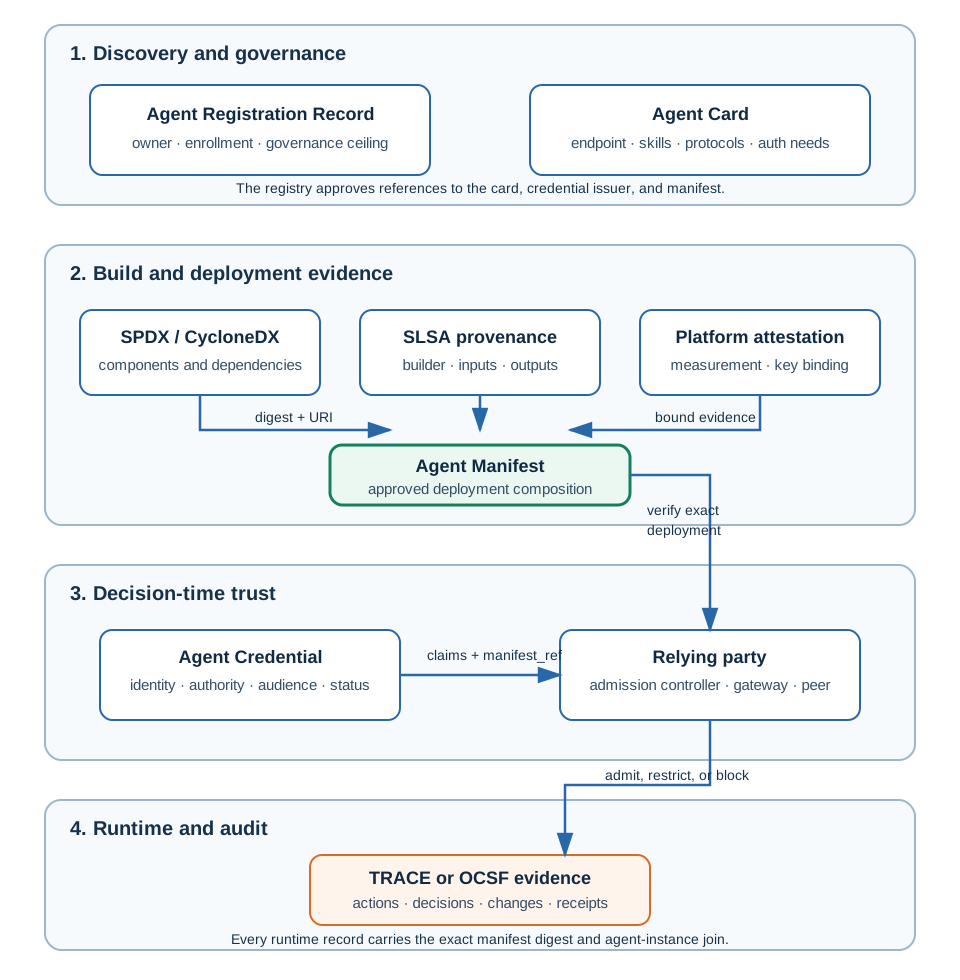
Open the diagram full size for readable labels. Select the image to open it in a new tab.
The arrows are references, not schema ownership transfers. Agent Manifest binds the digests and identifiers needed to verify a deployment. It does not copy the source records into a new umbrella schema.
See it working
Pick the depth that fits the question you are trying to answer:
Five minutes: prove deployment drift is detected
Run the multi-artifact tamper-detection example. It signs a manifest over a real prompt, model descriptor, tool catalog, and RAG corpus, verifies the approved state, changes the prompt, and shows verification returning MISMATCH.
git clone https://github.com/agentrust-io/agent-manifest
cd agent-manifest
bash examples/multi-artifact/verify.sh
Fifteen minutes: follow declaration through enforcement to evidence
The industrial embodied-AI example connects all three layers in one scenario:
- Agent Manifest declares the approved prompt, policy, tools, and artifact hashes.
- cMCP evaluates each requested action against the active Cedar policy and tool catalog.
- TRACE and the signed audit bundle preserve the session and decisions for offline verification after the processes stop.
The example includes allowed, out-of-scope, and independently safety-rejected paths. Its limitations table states exactly what each record proves and what it does not prove.
Browse integrations and runnable demos
- cA2A cross-operator delegation is a runnable 12-check tutorial. It shows one agent giving another agent a smaller set of permissions, the receiving agent applying its own policy, and an auditor checking the delegation and evidence later. Its SEV-SNP evidence is synthetic, so it demonstrates the protocol without claiming a live hardware run.
- AgenTrust demos provides ten runnable policy, attestation, TRACE, and model-custody demonstrations that need no confidential-computing hardware.
- AgenTrust Marketplace lists open adapters, plugins, platforms, and evidence exporters. Marketplace presence is discovery, not an endorsement; verify each listing and its evidence for your own deployment.
- Your first manifest walks through creation and signing, and server-side verification shows the relying-party side of the diagram.
Record boundaries
| Record | Answers | Carries or references | Must remain outside it |
|---|---|---|---|
| Agent Registration Record | Which agent is enrolled, who owns it, and what governance ceiling applies? | Approved Agent Card, credential issuer, and manifest reference | Deployment internals and live authorization grants |
| Agent Card | Where is the agent and what protocols, skills, and authentication requirements does it advertise? | Manifest URI, digest, and media type | Secrets, live credentials, and deployment evidence copied from the manifest |
| Agent Credential | Who or what is presenting a claim, under whose authority, for which audience, and with what current status? | Exact manifest reference and, when needed, runtime-evidence reference | Prompt, model, tool catalog, BOM, and other deployment content |
| Agent Manifest | What immutable deployment composition was approved before execution? | Typed digests and URIs for the BOM, provenance, Agent Card or identity context, policy, tools, model, and attestation evidence | Discovery metadata, credential lifecycle state, live delegation grants, and actions that have not happened |
| SPDX or CycloneDX BOM | Which software, model, dataset, service, and dependency components are declared? | Component identities, relationships, and hashes | Agent identity, authority, and runtime decisions |
| SLSA provenance | How was an output built, from which inputs, by which builder? | Subjects, materials, builder, and process evidence | Agent policy, authority, and runtime behavior |
| RATS/EAT or platform evidence | Which workload measurement and key binding did the platform attest? | Platform claims, measurements, nonce or freshness evidence, and bound data | Semantic description of every agent artifact |
| TRACE or OCSF runtime evidence | What was observed, evaluated, changed, or committed after admission? | Manifest digest, agent-instance identifier, action and decision records, integrity data | A claim that the record is complete or that observed behavior was correct |
Minimal common reference
Agent Cards, credentials, and registration records should be able to carry the same small reference. The carrier signs the reference according to its own rules; the manifest retains its own signature and attestation binding.
{
  "manifest_ref": {
    "uri": "https://agent.example/manifests/sha256:7e1f...9a02",
    "digest": "sha256:7e1f...9a02",
    "media_type": "application/agent-manifest+cose"
  }
}
The exact carrier fields remain work for the owning standards. The integration invariant is that the URI is resolvable, the digest identifies the exact signed bytes, and the media type selects the correct verifier. A mutable agent-level URL without a digest is not enough for an audit or authorization decision.
Verification sequence
At a relying party such as an admission controller, MCP gateway, or A2A peer:
- Authenticate the registration record, Agent Card, or credential according to the carrier's rules.
- Resolve
manifest_ref.uriand confirm that the retrieved signed bytes matchmanifest_ref.digestandmanifest_ref.media_type. - Verify the manifest's issuer authorization, signature or COSE envelope, validity window, revocation status, required artifact bindings, and required attestation.
- Resolve and verify referenced BOM and provenance records when policy requires their contents, rather than treating a present digest as sufficient.
- Apply local policy to admit, restrict, or block the requested operation. A
VALIDmanifest establishes provenance, not permission. - Emit runtime evidence carrying the exact manifest digest and a distinct agent-instance identifier. A stable agent identity must not be substituted for a session or workload-instance identity.
- For later credential decisions or audits, verify the runtime record independently and join it to the exact manifest used at admission.
Lifecycle and change rules
| Change | Record that changes | Required consequence |
|---|---|---|
| Endpoint, advertised skill, or protocol changes | Agent Card | Reissue the card; update its registration reference if governance requires it |
| Owner, enrollment, or governance ceiling changes | Registration record | Reissue or update the registration record under registry policy |
| Identity, authority, audience, or status changes | Agent Credential | Issue, attenuate, refresh, revoke, or replace the credential |
| Prompt, policy, model, tool surface, approved context baseline, or dependency reference changes | Agent Manifest | Build and sign a new manifest; repeat attestation binding where the conformance level requires it |
| Build input or output changes | SLSA provenance and usually the Agent Manifest | Produce new provenance and bind its new subject or record digest |
| Component inventory changes | BOM and usually the Agent Manifest | Produce a new BOM and bind its new digest |
| Runtime task, memory, delegation hop, tool decision, or receipt occurs | Runtime evidence | Emit a new evidence record joined to the admitted manifest and agent instance |
Security limits
- A signature protects record integrity. It does not prove completeness, correctness, or safe behavior.
- Platform attestation measures a workload boundary. It does not semantically measure provider-hosted models, external services, or every in-memory object.
- A manifest reference in a credential does not make the manifest an authorization token. The relying party still evaluates current authority and local policy.
- A runtime record that identifies only a stable agent cannot distinguish two concurrent or sequential instances. Runtime evidence needs an instance-scoped join key.
- Digests without retrieval, media-type selection, and content verification are identifiers, not completed verification.
- No confidential-computing platform provides custody-grade protection from an adversary that owns the physical hardware. Deployment claims must state their operator trust model.
Related material
- Agent Credentials integration describes the credential-to-manifest and runtime-evidence bridge in detail.
- Agent Manifest specification defines the normative manifest and verification behavior.
- CoSAI WS4 Agent Manifest review carries the review and disposition record for this boundary.